



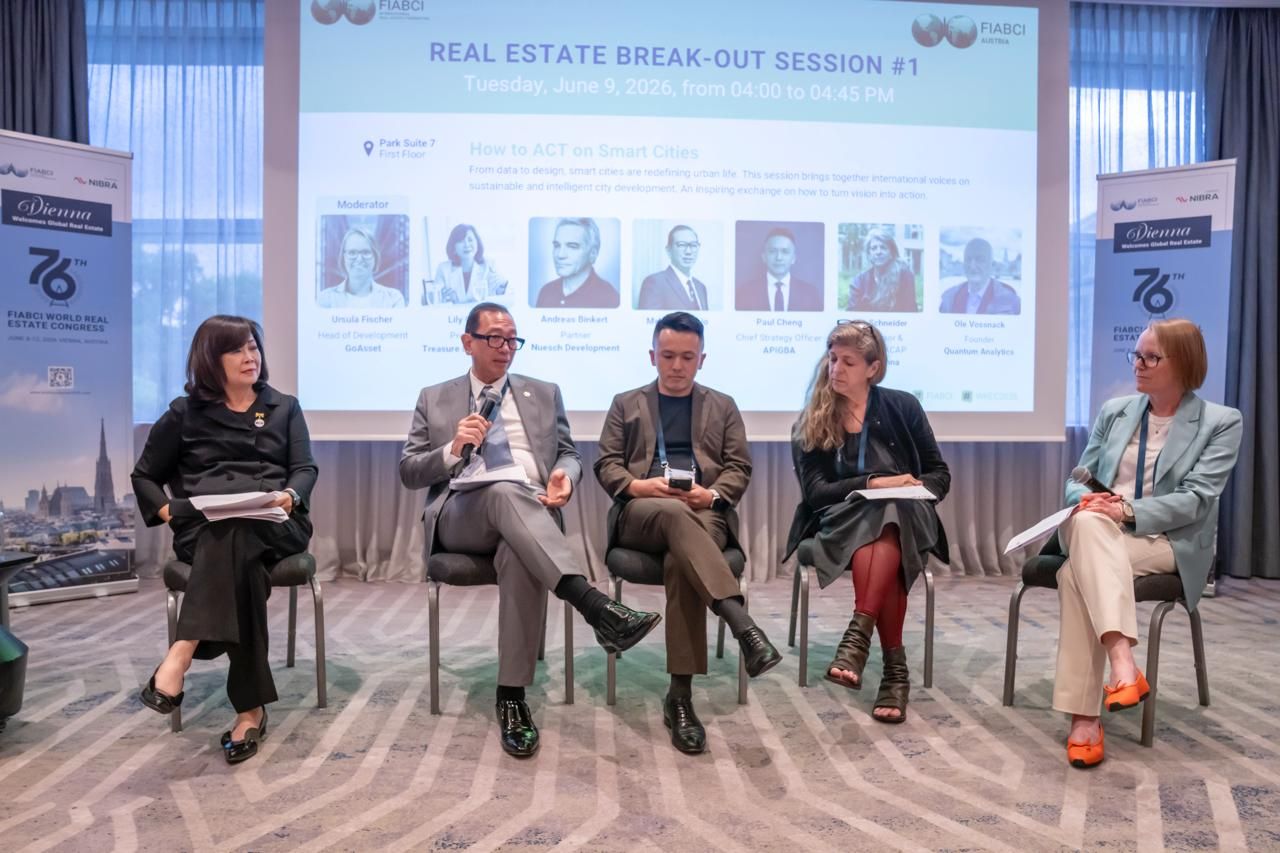
FIABCI World Congress Explores Practical Pathways to Smart and Sustainable Cities
As part of the FIABCI World Congress in Vienna, a breakout session titled “How to ACT on Smart Cities” was held on 9 June 2026, bringing together international experts, developers, and urban practitioners to discuss how cities can move from smart city concepts to practical implementation.
Joined by industry leaders and opened with keynote presentations by Andreas Binkert and Ole Vossnack, the session emphasized that truly smart cities are not defined by technology alone, but by their ability to create connected, resilient, and sustainable communities. The discussion highlighted the importance of mixed-use development, walkability, efficient infrastructure, community engagement, and data-driven decision-making as key foundations of successful smart cities.
Panelists shared perspectives from different regions, including the challenges of balancing commercial viability with sustainability goals, measuring progress toward net-zero development, and aligning municipalities, investors, developers, and communities around a common vision. Practical examples demonstrated how developers can contribute through green building practices, efficient resource management, transit-oriented planning, and the creation of healthy urban environments.
A recurring theme throughout the session was the need to move beyond isolated initiatives toward collaborative platforms that enable knowledge sharing, transparent data, innovative financing, and long-term stakeholder engagement. Participants agreed that achieving smart and sustainable cities requires coordinated action among governments, private sector actors, educational institutions, and local communities.
The session concluded with a clear message: the tools and technologies already exist, but success depends on the willingness of all stakeholders to ACT—through collaboration, innovation, and measurable commitments—to build cities that are not only smarter, but also more sustainable, inclusive, and resilient for future generations.
